

WELCOME TO THE HOMEOPATHY RESOURCES SECTION
Wondering about homeopathy and whether it might help your pet? You’ve come to the right place!
What is homeopathy?
This resource area has lots of information about the homeopathic medical system in seminar format. Homeopathy is a powerful, gentle, and effective way to work with your pet. However, it is not yet part of the practice of veterinarians in the US as it is in other countries but you can still learn how to use it along with your vet.
Personally I (Dr. Jeff) have found the practice of integrating homeopathy into modern veterinary science incredibly exciting and effective. This resource is a brief introduction to this wonderful system and my understanding of how it can be used within the current veterinary medical system.
Here are the important words we will need:
Homeo = Similar (like or with)
Anti = Opposing (opposite or against)
Homeo-pathy is a way to work with your pet’s body using symptoms as clues of internal imbalance.
Homeopathy (also known as homeopathic medicine), is a medical system that was developed more than 200 years ago by the genius scientist-physician Christian Friedrich Samuel Hahnemann. It is a holistic way to interpret changes in external and internal symptoms (which are called “signs” by veterinarians).
“Every symptom change reflects a physiologic change.”
Closely evaluating symptoms allows you and the vet homeopath to select homeopathic medicines which can help re-balance your pet’s vital systems.
Homeopathy is based on one primary principle (which homeopaths consider to be a natural:
“Like cures like”—the principle that a substance which can cause symptoms can treat similar symptoms. Homeopathic medicines can activate the natural healing processes of the body.
That sums it up! Using the “Law” of Similars and working with pets bodies to resolve abnormal symptoms.
What are homeopathic medicines and how are they made?
Homeopathic medicines are derived from plants, minerals, and animals. These include substances such as onion, poison ivy, nightshade, salt, arsenic, milk, bees, and many, many more. Homeopathic medicines can be used to coat sugar pellets to be placed under the tongue; they may also be in other forms, such as ointments, gels, drops, creams, tablets, and tinctures. The choice of the homeopathic medicine is individualized or tailored to each patient—it’s common for different pets who appear to have the same condition to receive different medicines.
The unique pharmacological process for making homeopathic medicines, called potentization, is where much of the controversy about homeopathy starts. Each medicine is, diluted in a 1:10 or 1:100 solution in double-distilled water in a glass test-tube that is vigorously shaken 40 or more times. This process of dilution and succussion (vigorous shaking) is repeated 3, 6, 12, 30, 200, 1,000, or more times. Based on our current understanding, it would seem that the solution (medicine) would be too dilute to have a therapeutic effect. However, both experience and science of nanotechnology show that these highly dilute substances medicines contain active particles and can have physiologic effects. This supports more than 200 years of successful treatment with homeopathic medicines. In addition, there are significant research studies showing the effect of homeopathic medicines in both people and animals.
How it’s Done
The process of homeopathy is NOT just giving the sugar pills. It involves a detailed initial evaluation, which commonly takes 1-2 hours, that starts with a full history of symptoms throughout your pet’s life including diagnostic test results. The goal is to characterize every aspect of their dis-ease (internal imbalance). Vet homeopaths determine their patient’s specific susceptibilities (sensitivities) to dis-ease producing agents and then use homeopathic medicines that work with nature and the body.
Homeopaths believe that homeopathy uses cellular communication pathways to activate natural healing in all animals. It is hypothesized to do this by providing vital cellular information that normalizes cell function and decreases abnormal symptoms and dis-eases.
Your Pet’s Individuality, Susceptibility and Symptoms
The concepts of individuality and susceptibility in homeopathy are keys to understanding how any pet (or person) will respond to a stressor and possibly (depending on susceptibility) develop dis-ease (imbalance).
Recent research is unlocking many “secrets” of the body. These include the molecular processes defining the individuality and susceptibility which are the foundations of choosing a homeopathic medicine.
These are concepts that transcend your pets genes and genome and are defined in molecular biology by the concept of the “exposome”. This relatively new ‘omic science has brought homeopathy closer to mainstream medicine. It describes the biochemical reactions that occur in people (and pets) in response to the environment throughout life (and even before birth).
As Hahnemann did with homeopathy, the Human Exposome Project is currently defining a new paradigm by which to understand medicine. This is extraordinarily exciting and starts to give us a bridge between homeopathy and mainstream medicine.
It’s All About Energy and Information
However, individuality and the exposome is just one of the puzzle pieces that explains how homeopathic care can stimulate the natural healing processes.
The other critical piece is the energy needed by all cells to work optimally in order for our pets to remain in balance and to not get dis-eased. This energy is well described by laws of physics which say that systems work better when they conserve energy. This is important for our companion animals because homeopathic medicines help them do this. Individualized remedies seem to “tune-up” your pet’s bodies to help them conserve energy and avoid the health challenges that occur when the fuel for the body runs low.
Think of it like a car that gets great mileage vs. one that is a gas guzzler. Fuel-efficient cars conserve energy (gas) whereas it gets used up faster by the gas guzzler. The same principle applies to the complex systems of the body which work most effectively when they are tuned-up to conserve the cellular energy needed by the cells to work properly and heal..
The principles of individuality, susceptibility, energy and internal balance are well described in the basic science literature. For example, the May 2020 article in a highly regarded journal of molecular biology says that “host response” to the SARS-CoV-2 virus and not the germ itself is what creates the symptoms of covid. In other words, susceptibility as when the immune system doesnt have energy to work properly, is more important for balance than exposure to a stressor (in this case a virus).
However, these important scientific concepts are not commonly connected to the ways that pet parents and vets can help pets. But you can do this by using these concepts yourself and sharing them with your vets. For example, when it comes to dis-eases like kennel cough or feline leukemia, they help explain how you can reduce your pet’s risk of dis-eases. You can easily use these principles along with homeopathy to help optimize their host responses.
If homeopathy is part of my pet’s treatment, what might I expect?
At Holistic Actions!, we teach HMDM (which stands for Holistic Medical Decision-Making) using homeopathy integrated into conventional medicine. They help you decide on and reach the goal of complete cure when possible. Some conditions can’t be completely cured, so we may aim for more attainable goals. The full range of outcomes include…
- Cure (resolving the underlying issue by fully restoring balance and vitality)
- Progress towards a cure (accepting that cure isn’t likely or possible in the near future, but has a good chance of being achieved over time)
- Palliation (making symptoms less severe or unpleasant)
- Suppression (eliminating symptoms without addressing the underlying imbalance that’s causing them)
- Nothing (sometimes homeopathic medicines appear to have no influence on the particular issue we’re trying to treat)
Let’s talk a little more about what you can expect from each.
CURE refers to the restoration or improvement of balance and vitality in your pet’s system, and thus to the resolution of both the underlying disease and its associated symptoms. When your pet has been cured by homeopathic treatment you will notice improvements in their BEAM (which stands for Behavior, Energy, Appetite and Mood).
Progress toward a cure refers to continued improvement of BEAM and specific symptoms, but incomplete resolution of the health challenge. Your pet is better and is responding to treatment but changes in primary symptoms may not yet be detectable.
PALLIATION refers to approaches that bring rapid relief but require ongoing management to prevent the recurrence of symptoms. The symptoms are being covered up. There’s no deep healing in palliation, it just provides temporary relief, in much the same way that an oatmeal bath can help to soothe your pet’s itchy skin. By definition, palliation means that symptoms return once you cease to manage them. This is your pet’s system’s way of telling you that the underlying issue has not been addressed.
SUPPRESSION also involves quick and often total relief. Eventually, your pet may respond with more serious symptoms that once again signal that the underlying issue (imbalance) has not been addressed and cured. There are times when suppression may make sense in the short term. However, this will always come at a cost, since this approach tends to worsen the underlying imbalance. When you silence the “smoke alarm” of symptoms without putting out the “fire” of the underlying imbalance, the fire just gets bigger and does more damage.
Homeopathic medicines are just one prong in a much broader holistic approach to health. At Holistic Actions!, we give you the resources to optimize every aspect of your pet’s life and health. This includes optimizing diet, nutrition, supplementation, socialization supports, exercise and enrichment activities. We also aim to neutralize or reduce the impact of genetic predispositions, vaccinations, history of abuse or neglect, and other adverse exposures. This empowering big picture approach enables you to restore your pet’s inner balance, boost their vitality, make them more immune to disease, and help them live the healthy happy life they deserve!
LEARN MORE
Homeopathy Seminars
VITALITY, BALANCE AND INTRODUCTION TO HOMEOPATHY FOR ANIMALS 2018
Watch this comprehensive 2 day seminar and learn the basic principals of homeopathy and how you can use it at home.
VITALITY, BALANCE AND INTRODUCTION TO HOMEOPATHY FOR ANIMALS 2019
Same basic content as previous 2018 seminar – worth watching again – with new information and new cases.
INTERMEDIATE HOMEOPATHY FOR ANIMALS 2019
A follow up intermediate seminar – a deeper dive into homeopathy.
VIDEOS
Homeopathy Webinars
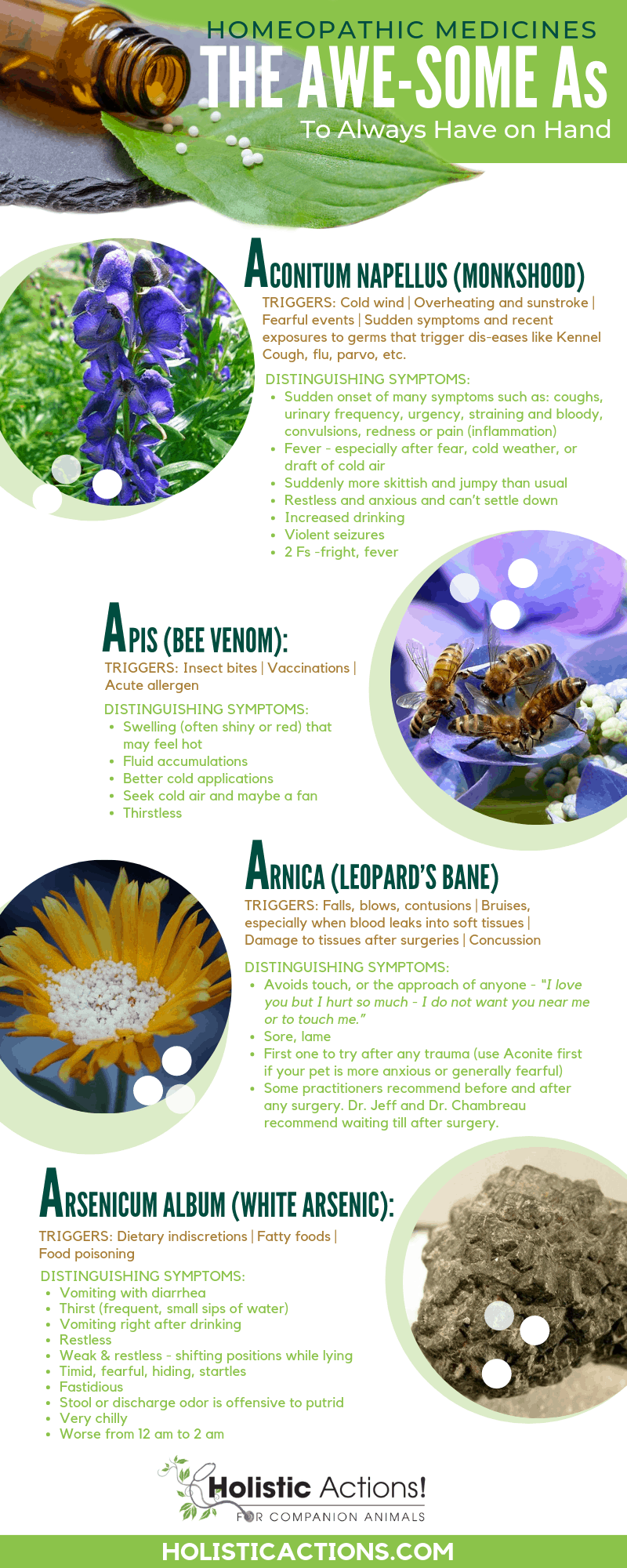
DOWNLOAD
4 Homeopathic First Aid Remedies
The 4 remedies that everyone should have and use. Click the image to download the pdf version. And click the button below for a more comprehensive handout.
Homeopathy Ebooks
No Results Found
The page you requested could not be found. Try refining your search, or use the navigation above to locate the post.
ARCHIVE
Homeopathy Webinars
All the Pet Health webinars! below cover aspects of homeopathy.
Read the descriptions and topic lists next to the videos to find your topics of interest.
06/15/2020 Empower Hour! Acute Homeopathy
SUMMARY: Dr. Lisa Melling gave a fantastic talk about using homeopathy for problems like injuries, urinary obstructions, heat stroke and bloat, on your way to the...
05/25/2020 Empower Hour! Describing Symptoms
SUMMARY: Tonight, Dr. Christina taught us more about collecting and describing symptoms, which is the process of homeopathic case taking. One thing we learned was...
04/27/2020 Empower Hour! Modalities
SUMMARY: Tonight we took a deep dive into symptom modifications, also called modalities. These are changes in the environment that make a symptom better or worse....
BLOG
No Results Found
The page you requested could not be found. Try refining your search, or use the navigation above to locate the post.